


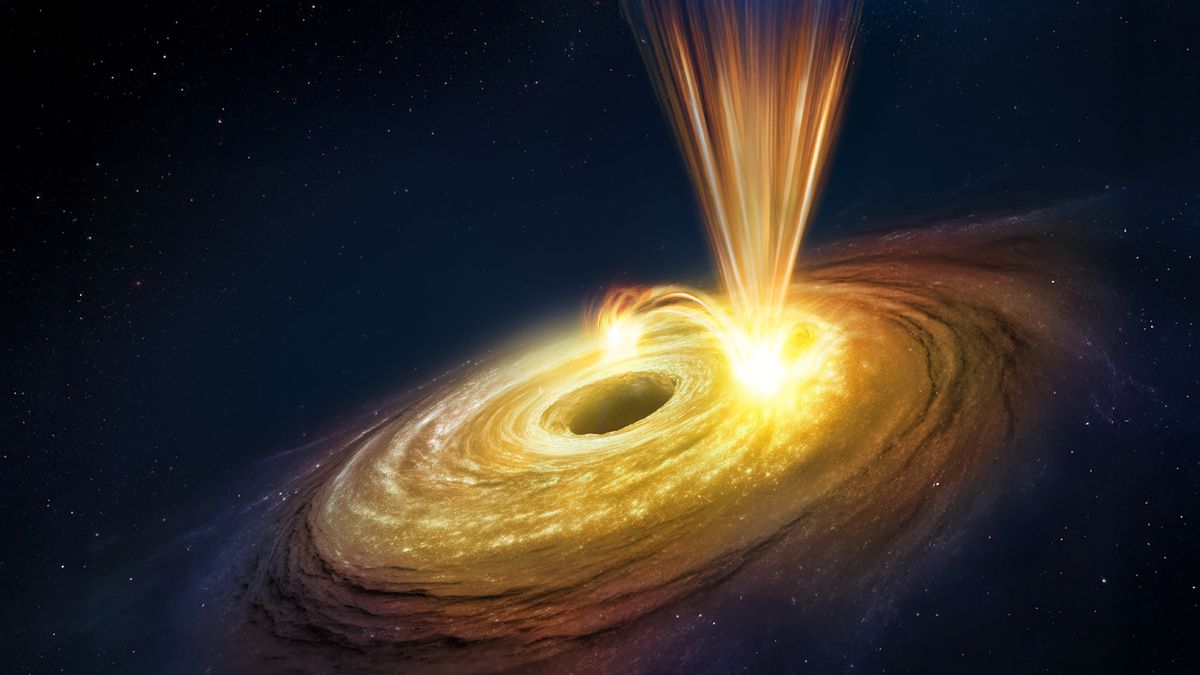
Galaxy NGC 3783 is gorgeous, with well-defined spiral arms that make it almost the platonic ideal of spiral galaxies. That beauty hides a powerful secret; at its core lies an extremely active supermassive black hole, and it is releasing winds at a speed like nothing we have seen before.
The rest of this article is behind a paywall. Please sign in or subscribe to access the full content.
Supermassive black holes are complex beasts. When abundant material reaches them, they can become active. The process of gobbling up interstellar plasma is a messy one, and the plasma gets so hot that it can be flung out in powerful winds.
For the supermassive black hole inside NGC 3783, these winds get to one-fifth of the speed of light: a record-breaking release. Using both the European Space Agency’s XMM-Newton and the X-Ray Imaging and Spectroscopy Mission (XRISM), a JAXA-led mission with ESA and NASA participation, researchers tracked a bright X-ray flare from the black hole, and as it faded, the incredible winds appeared.
“We’ve not watched a black hole create winds this speedily before,” lead researcher Liyi Gu at Space Research Organisation Netherlands (SRON) said in a statement.
“For the first time, we’ve seen how a rapid burst of X-ray light from a black hole immediately triggers ultra-fast winds, with these winds forming in just a single day.”
The supermassive black hole, which is about 130 million light-years from Earth, has a mass of 30 million times our Sun. Its feeding is so intense that the whole central region is classified as an Active Galactic Nucleus (AGN).
“AGNs are really fascinating and intense regions, and key targets for both XMM-Newton and XRISM,” explained Matteo Guainazzi, ESA XRISM Project Scientist and co-author of the discovery.
“The winds around this black hole seem to have been created as the AGN’s tangled magnetic field suddenly ‘untwisted’ – similar to the flares that erupt from the Sun, but on a scale almost too big to imagine.”
The similarity between solar phenomena and supermassive black hole events, even at different scales, might allow us to understand both processes better. AGNs can truly shape the evolution of their galaxies, so it is paramount for astronomy to unlock their secrets.
“Windy AGNs also play a big role in how their host galaxies evolve over time, and how they form new stars,” added Camille Diez, a team member and ESA Research Fellow. “Because they’re so influential, knowing more about the magnetism of AGNs, and how they whip up winds such as these, is key to understanding the history of galaxies throughout the universe.”
The study is published today in Astronomy & Astrophysics.