


While The Matrix is rightly billed as the most successful and inventive science fiction film of the 1990s, Alex Proyas’ criminally overlooked Dark City deserves to be mentioned on the same level. After all, the Wachowski siblings were so impressed by the visual tableau and production design of Dark City that they purchased props and parts of the set and recycled them in the first Matrix movie. Fusing neo-noir tropes with science fiction tenets and a splash of old-school horror, Proyas set out to make a disorienting Kafkaesque nightmare on par with a classic Twilight Zone episode.
Alas, when New Line Cinema saw Proyas’ original vision, they deemed Dark City too confounding for audiences to understand and forced Proyas to simplify the story by adding an unnecessary voice-over narration to explain what transpires. In 2008, ten years after the film was released theatrically, Proyas edited a new director’s cut that eliminated the expository narration and challenged the audience to do the work and follow the story themselves. Regardless of which version you prefer, we’re tuning and tunneling deep into the architectural substructure beneath Dark City to discover what the f*ck happened to this movie nearly 30 years ago.
Development
Alex Proyas began writing the script for Dark City in 1990, four years before his sophomore feature film, The Crow, was released. Proyas conceived a story that would blend elements of film noir, Gothic horror, and steampunk science fiction, citing the 1940s detective classic The Maltese Falcon as a major influence. Also inspired by Fritz Lang’s Metropolis and Rod Serling’s The Twilight Zone, Proyas deliberately set out to unnerve audiences with an unforgettably nightmarish experience.
Upon writing the script, Proyas focused on a 1940s gumshoe who obsesses over getting the facts of a crime case correct. But when the facts don’t add up to make logical sense, the detective begins losing his sanity and spirals out of control. Reaching a dead end, Proyas redirected course by shifting the spotlight to the criminal whom the detective is pursuing—amnesiac murder suspect John Murdoch.
After completing a first draft, Proyas passed the script to David S. Goyer and Lem Dobbs. Goyer had already written The Crow: City of Angels, and Proyas was so impressed by Goyer’s script for the yet-to-be-released Blade that he recruited him for Dark City. Dobbs, who wrote Kafka for Steven Soderbergh earlier in the decade, seemed ideal for the wildly outlandish sci-fi tale. It’s understood that Dobbs rewrote most of Proyas’s original script and is responsible for the vast majority of the movie we all know and love, save for the scenes requiring special visual effects. Once Dobbs tightened the script, Goyer wrote the shooting script, adding the FX-driven action sequences and the mechanics of the city’s nocturnal operation.
Casting
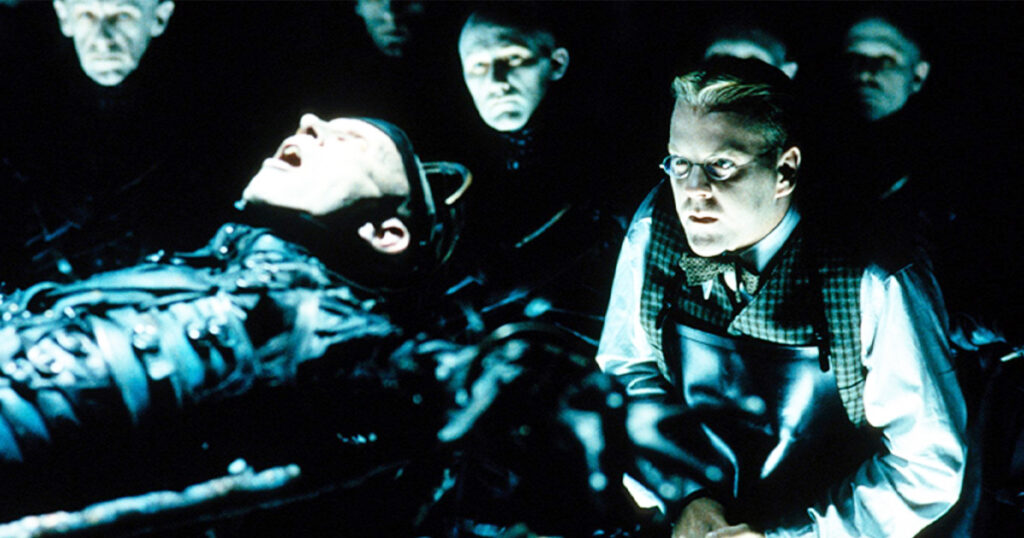
With the script in order, Proyas set out to cast the movie. Although he was familiar with Rufus Sewell’s work, Proyas cast him as John Murdoch because he felt audiences wouldn’t recognize him as a big-name movie star and that his anonymity would help mystify the character and add to the story’s intrigue.
Richard O’Brien was always Proyas’s first choice to play Mr. Hand, one of the bald, pale Strangers assigned to tracking down Murdoch. Proyas wanted an “ethereal, androgynous” quality and specifically wrote the part for him, inspired by O’Brien’s performance as Riff Raff in The Rocky Horror Picture Show. The child companion of Mr. Sleep was played by Satya Gumbert and her twin brother Noah Gumbert, both massive Rocky Horror fans.
The key role of Dr. Daniel P. Schreber was named after real-life German judge Daniel Paul Schreber, whose autobiography Memoirs of My Nervous Illness heavily influenced the film’s themes. Concepts such as “fleetingly improvised men” and the cage-like head apparatus were drawn directly from Schreber’s writings.
William Hurt ultimately played Detective Frank Bumstead, though he was initially offered the role of Schreber. Sir Ben Kingsley was also considered. Kiefer Sutherland, when offered the role, initially assumed the script was meant for his father, Donald Sutherland, but agreed to participate anyway.

Production Design & Visual Style
After The Crow, Proyas reunited with cinematographer Dariusz Wolski and production designer Patrick Tatopoulos. Proyas asked Tatopoulos to imagine a city in constant flux—one built from fragments of different places, intentionally disorienting.
The Strangers’ original design as bug-like creatures was abandoned in favor of pale, corpse-like entities inhabiting human shells. Early drafts even featured a robotic guard dog with steel jaws.
Principal Photography
With a $27 million budget, Dark City filmed from December 1996 to April 1997 in New South Wales, Australia. The entire city was constructed on soundstages—no real locations were used, aside from the ocean pier shot at the end.
Proyas avoided the exaggerated artifice of Tim Burton’s Gotham City, opting instead for a grounded yet uncanny environment. Tatopoulos described the city as a patchwork of global architecture, designed to feel familiar but placeless.
The film was shot on 35mm using a Panavision Panaflex Gold II camera, with extensive use of natural light sources like street lamps. Sets such as the Strangers’ underground lair reached heights of 50 feet, far taller than standard soundstage builds.
The Ending, the Confusion, and Studio Panic
Proyas originally envisioned a Kafka-esque courtroom ending inspired by Orson Welles’ The Trial. That version was scrapped in favor of Shell Beach, but preview audiences were baffled by the physics of the city floating in space.
To clarify matters, force-field effects were added. Despite this, confusion persisted, leading to the dreaded opening narration—something Proyas loathed and later removed in the 2008 director’s cut.
Release & Reception
Originally intended for a 1997 release, Dark City was delayed to February 27, 1998. Title changes were briefly considered due to studio concerns, but the original title was restored after Mad City flopped.
The film grossed $27.2 million worldwide against its $27 million budget. While not a hit, it earned strong critical acclaim. Roger Ebert named it the best film of 1998 and later added it to his Great Movies list.
As of 2025, Dark City holds a 78% Tomatometer score, an 85% audience score, a 66 Metascore, and a 7.6 IMDb rating.
The Director’s Cut vs. Theatrical Cut
The 2008 director’s cut removes the opening narration and restores 11 minutes of footage. Changes include:
- Jennifer Connelly’s real singing voice in the nightclub
- Extended scenes clarifying Anna/Emma’s false memories
- Added spiral imagery reinforcing the Strangers’ control
- New character moments humanizing the murder victims
Final Take
Despite studio meddling and box-office disappointment, Dark City has only grown in stature. Its influence on The Matrix, Inception, and modern sci-fi is undeniable. While the theatrical cut was compromised, the director’s cut restores Alex Proyas’ original intent—cementing Dark City as one of the most visually and thematically daring science-fiction films of the 1990s.