


It’s time to travel back into that lonely town, the one where the fog feels permanent and the sirens blare loudly. No, not the terrible 3D sequel Revelation, but the original film journey that came out 20 years ago.
With a new Silent Hill movie on the way from the same creator as the first, the question naturally comes up: is this a second chance at a good sequel, or just a soft remake? We’ll find out soon enough. But before that release arrives, it’s time to look back and see whether Silent Hill (2006) still stands the test of time.
How has it aged? Is it better than we remember, or just a foggy memory warped by nostalgia? How do the acting, special effects, and, most importantly, faithfulness to the game series hold up after two decades? And how did one of the better video game adaptations manage to come out during an era when most of them were… frankly awful?
Let’s head back into the fog together and find out if Silent Hill still stands the Test of Time.
Plot and Production Background
The Silent Hill video game franchise began in 1999, right in the middle of the survival horror boom popularized by Resident Evil in 1996. It was a major success for Konami, with new entries released in 2001, 2003, and 2004.
French director Christophe Gans, who had previously worked on Necronomicon: Book of the Dead and Crying Freeman, decided during the production of Brotherhood of the Wolf that Silent Hill would make a perfect film adaptation. Gans was a genuine superfan. Like other passionate filmmakers before him, he put together a 37-minute presentation, complete with Japanese subtitles, to pitch Konami. The studio quickly realized he was the only filmmaker who truly understood the heart of the franchise and could give it the creative pulse it deserved.
Screenwriting duties fell to Roger Avary, the Oscar-winning writer of Pulp Fiction. Avary was given atmospheric materials from Gans and also played through all existing Silent Hill games while writing the script. During this process, he discovered the real-life Pennsylvania town of Centralia, which became the inspiration for the film’s cursed setting. This allowed the movie version of Silent Hill to have both a mythic reputation and a tragic cinematic backstory.
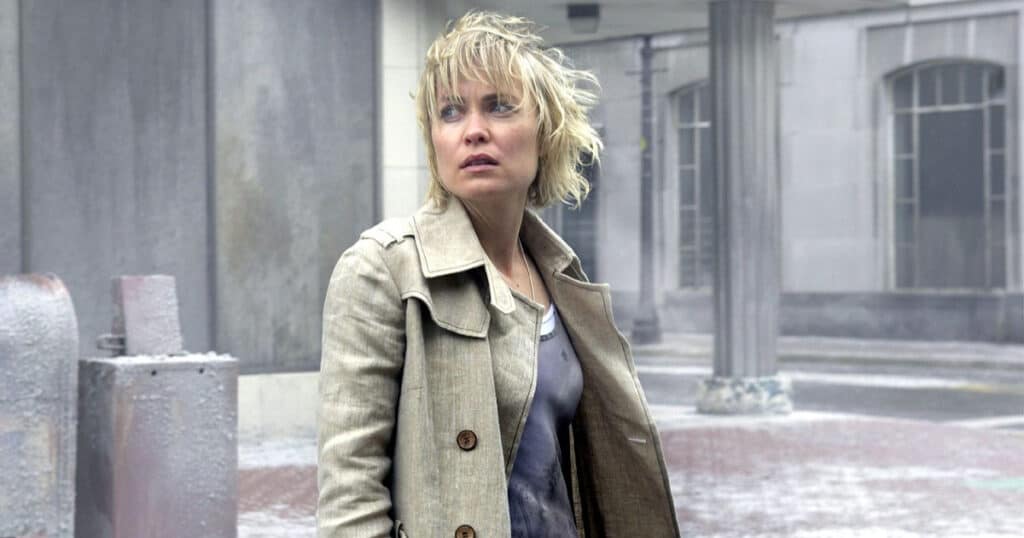
The first draft was completed in October 2004, but producers rejected it for one surprising reason: it had no male characters. Because Avary’s involvement was public knowledge, fans, whom he lovingly referred to as “crazy,” and he’s not wrong, flooded him with their own scripts and, unfortunately, even death threats. While Avary and Gans didn’t always see eye to eye creatively, Avary ultimately yielded to Gans’ unrelenting passion for the project.
Casting, Music, and Visual Style
The cast includes Radha Mitchell, Sean Bean, Laurie Holden, Kim Coates, Deborah Kara Unger, Alice Krige, and Jodelle Ferland, with Bean’s character added only after the studio demanded a male lead. The role of Rose nearly went to Meg Ryan or Milla Jovovich, but Mitchell was chosen instead. She was coming off strong performances in Finding Neverland, Melinda and Melinda, and Man on Fire, though her acting style reportedly frustrated Gans due to the number of takes required.
The film’s music is pulled almost entirely from the Silent Hill games, with the notable addition of a Johnny Cash song. Cinematography was handled by Dan Laustsen, a frequent collaborator of Guillermo del Toro, and it shows.
Story Overview
The film loosely adapts elements from the first two Silent Hill games. Rose takes her adopted daughter, Sharon, to Silent Hill in a last-ditch attempt to cure her recurring nightmares. After a car accident involving police officer Cybil, Rose awakens in the fog-shrouded town, only to find Sharon missing.
As Rose searches for her daughter, she encounters shifting realities, horrific creatures, a cult responsible for burning a young girl who looks eerily similar to Sharon, and a towering executioner with a pyramid for a head. Meanwhile, her husband searches for them in what appears to be a different plane of existence altogether.
By the end, Rose and Sharon are reunited, along with Alessa, but never make it back to our world. The film earned nearly $101 million on a $50 million budget, yet critics largely dismissed it, arguing that its visuals couldn’t save a “video game–style” story.
So… were they right?
Signs of the Time
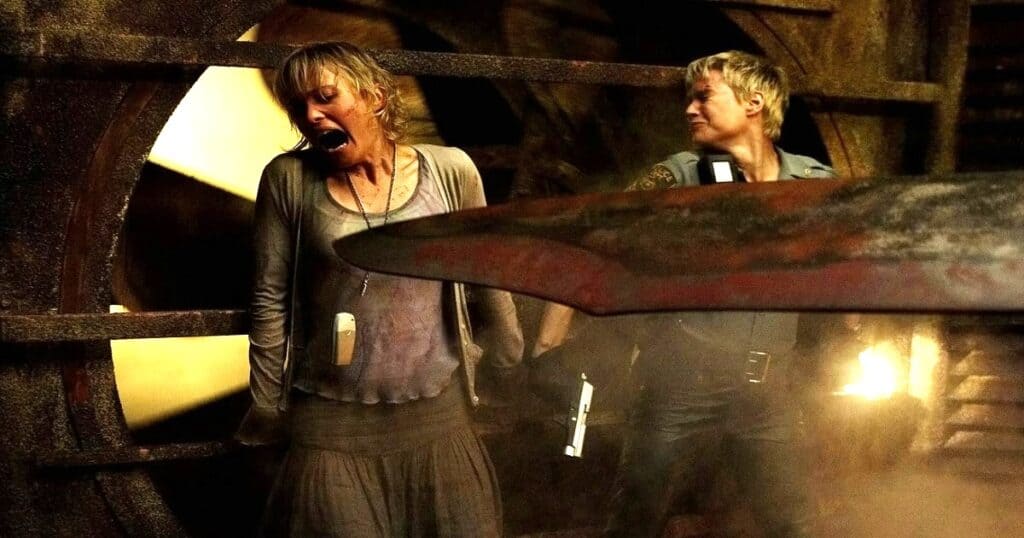
There are plenty of reminders that this movie is firmly rooted in 2006. The cellphones, especially the chunky one Rose wears around her neck, are pure nostalgia. These were devices that played Snake and little else, nowhere near today’s pocket-sized supercomputers.
The websites shown in the film are equally charming, looking like fan-made pages you’d stumble upon while deep-diving a band or celebrity at 2 a.m. And of course, there’s the big question every early-2000s movie raises: how does the CGI hold up? Thankfully, Silent Hill mostly landed on the right side of that gamble.
This era was also peak video game adaptation madness. Not quite the experimental ‘90s (Super Mario Bros., Mortal Kombat), and far from today’s prestige era (The Last of Us, Fallout). This was a box-office-driven genre, with films like Doom, House of the Dead, Tomb Raider, Final Fantasy, and Resident Evil flooding theaters. Unlike later adaptations made when franchises were already fading, Silent Hill was still a thriving IP at the time.
Some elements aged like fine wine. Others… not so much.
What Holds Up
I’ll admit it, I had mostly written this movie off. As a huge fan of the games, I was disappointed by some of the changes. Watching it again 20 years later, though, I was genuinely impressed by several aspects.
First and foremost: the music. Using the game’s original soundtrack is pure fan service, but it works beautifully. Hearing that opening theme kick in under the Warner Bros. logo still hits just as hard as it did in theaters. It’s one of the best examples of respecting source material and immersion, rivaling what The Last of Us accomplished decades later.
The acting is mostly… fine. But Laurie Holden as Cybil stands out. She strikes a perfect balance between subtle character work and emotional authenticity without slipping into overacting or disengagement like some of her co-stars.
The production design is outstanding. Silent Hill feels like a seamless blend of the game’s nightmare logic and the real-world inspiration of Centralia. The transition sequences paired with the air raid siren remain some of the strongest visual moments of the era. The constant falling ash not only looks good, but reinforces the themes of disorientation and loss.
The monster design also deserves praise. These aren’t generic CGI creations; many are portrayed by real contortionists, with CGI used sparingly to enhance their unnatural movements. Pyramid Head, while arguably misplaced lore-wise, is terrifying here. His infamous church scene is easily the film’s most memorable kill.

What Doesn’t Hold Up
Unfortunately, not everything survived the fog.
Much of the acting veers between flat and overly theatrical. Kim Coates performs well, and Radha Mitchell is serviceable, but many others either sleepwalk through scenes or drift into near-parody. The plot also struggles. Whether you’re a fan frustrated by lore changes or a casual viewer confused by the Alessa/Sharon connection, the story can feel muddled.
The runtime doesn’t help. While it’s great that Gans was allowed to make his movie, the Sean Bean subplot feels unnecessary. His character exists mainly to deliver exposition, and every time the film cuts back to him, momentum grinds to a halt.
Lastly, while most effects hold up, the fire effects, especially during Cybil’s execution, look rough and noticeably artificial.
Final Verdict
Silent Hill (2006) isn’t perfect, and it definitely falls into some classic video game adaptation traps. Still, it’s a strong watch, especially for fans of the games, and has arguably aged better than expected. The visuals remain striking in high definition, making the Scream Factory release well worth owning.
If Christophe Gans is getting a second chance at this franchise 20 years later, the original movie deserves one too.
What do you think of Silent Hill? Are you excited for the upcoming installment? Let me know. I’ll be avoiding Pyramid Head and air raid sirens if anyone needs me.
A couple of the previous episodes of The Test of Time can be seen below. To see more, click over to the JoBlo Horror Originals YouTube channel – and subscribe while you’re there!