



Image source: Getty Images
Parents can pay just £2,880 a year into a child’s SIPP (Self-Invested Personal Pension) — the government tops it up to £3,600. Given enough time, the results are extraordinary.
The mechanics are simple but powerful. Parents and grandparents can pay up to £2,880 per year into a child’s SIPP — and even though the child pays no tax, the government adds 20% relief, bringing the total annual contribution to £3,600. That’s it. That’s the whole strategy.
Let’s assume that the parents, and then the child, maintain those contribution for the next 55 years. Admittedly, by the end of the period — 50-odd years from now — the contributions would actually be quite small relative to the value of money.

Time does the heavy lifting
Assuming the money is invested in global stocks returning 11% annually — broadly in line with the S&P 500‘s performance over the past 55 years — those modest contributions compound into something remarkable. After 20 years the pot sits at around £230,000. After 35 years, £1.2m. By year 55, just over £10m.
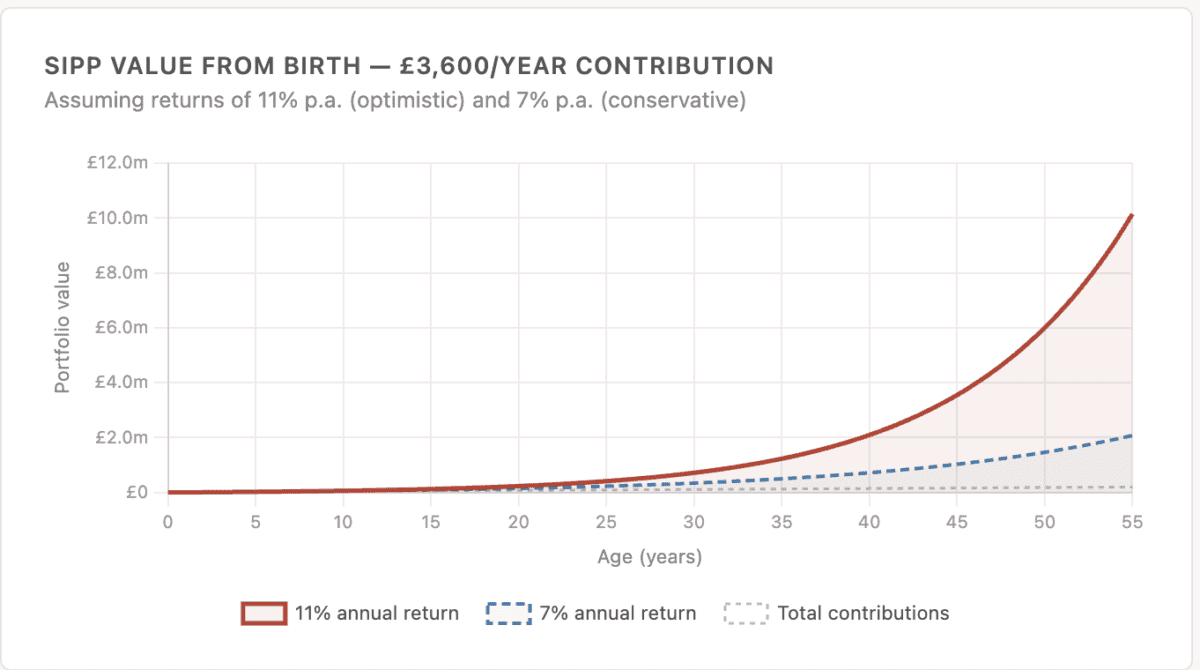
The really striking thing is how much of that growth happens at the end. The final decade alone adds more than £6m — more than the preceding 45 years combined. This is what compounding actually means in practice: the longer it runs, the faster it accelerates. The total amount paid in over 55 years is just £198,000. The rest — more than £9.9m — is pure growth.
There are caveats, of course. The money is locked away until at least age 57 under rules coming into force in 2028. Returns of 11% are not guaranteed — markets can disappoint for years at a time.
And many families simply cannot commit £2,880 per year from birth. But it’s worth playing around with the numbers. Even tiny contributions — say £20 per month — can make a huge difference over time.
Where to invest?
For long-term SIPP investors, few investment trusts make a stronger case than Scottish Mortgage Investment Trust (LSE:SMT).
Run by Baillie Gifford, the investment trust does something most retail investors cannot: access exceptional private companies before they list.
This is clear from its larger holding — SpaceX. The company is valued at £800bn on Scottish Mortgage’s balance sheet, but that figure could double if SpaceX moves forward with its listing this year — it already represents around 16% of the portfolio.
The company also provides investors with instant diversification, owing a host of household names and companies you’ve never heard of.
The philosophy is patient — positions held for years, sometimes decades, ignoring short-term noise. That comes with real risk: the trust fell more than 50% in 2022 as growth stocks re-rated sharply. What’s more, concentrated private holdings can be illiquid and hard to value accurately.
However, it’s certainly an interesting proposition, and well worth considering.