


Herpesviruses and humans are old companions. To help uncover our relationship with this ubiquitous gang of viruses, scientists have reconstructed ancient genomes of herpesviruses from ancient human remains.
An international research team led by the University of Vienna in Austria and the University of Tartu in Estonia, as well as the University of Cambridge and University College London, screened nearly 4,000 samples of human skeletons from archaeological sites across Europe.
This allowed them to track the evolutionary paths of two herpesviruses – human betaherpesviruses 6A and 6B (HHV-6A/6B) – as they adapted alongside humans.
Over 100 herpesviruses are known to science, but just nine routinely infect humans as their primary host. Many of these are extremely widespread among most human populations; whether you know it or not, there’s a good chance you have been infected by these viruses.
HHV-6A and HHV-6B are among the more common of the batch. It’s estimated that HHV-6B infects roughly 90 percent of children and often results in fever, diarrhea, and a pinkish rash. Along with its close relative HHV-6A, it typically causes a mild illness before remaining dormant, lurking in the body for life.
This pair of herpesviruses was only identified in the 1980s. However, as these historical skeletons show, they’ve been deeply embedded in the human population for a very long time.
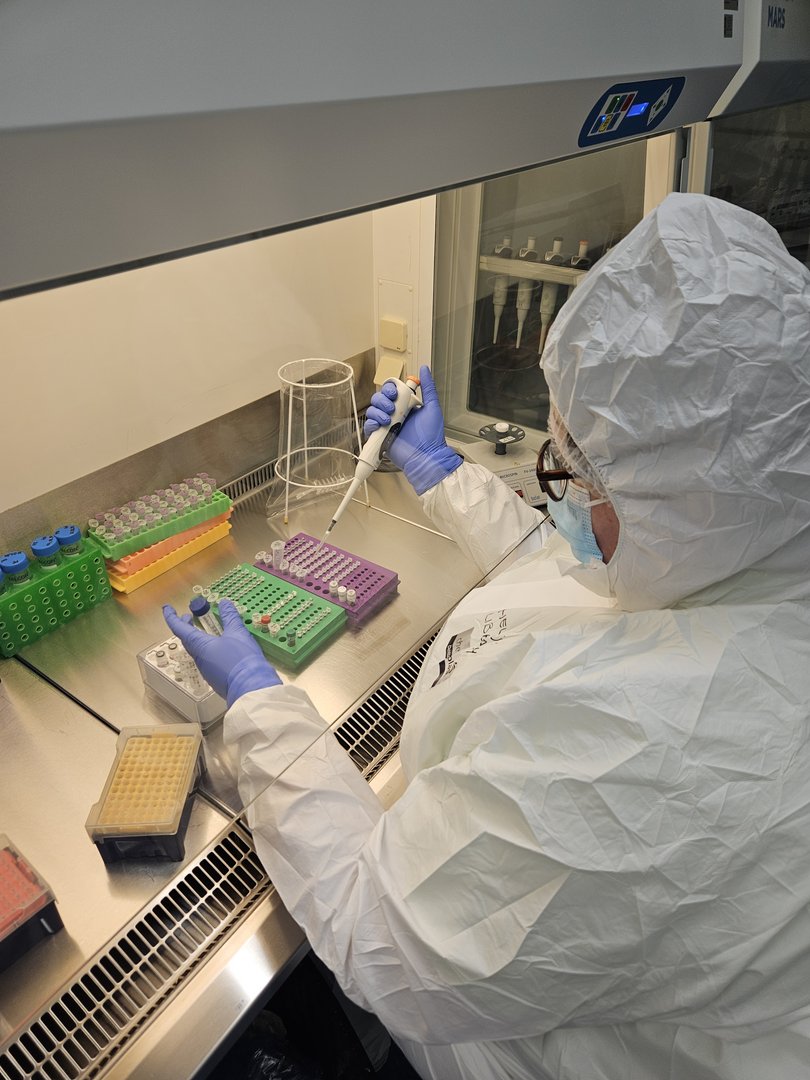
A scientists at the University of Tartu extracts tiny amounts of DNA from centuries-old skeletons.
Image credit: University of Tartu Institute of Genomics Ancient DNA Laboratory
HHV-6A and HHV-6B were detected in medieval remains from England, Belgium, and Estonia, while HHV-6B was found in ancient samples from Italy and Russia. This included people from both farming settlements and hunter-gatherer communities, suggesting these viruses were circulating widely across different human societies and cultures long before the modern era.
Altogether, they reconstructed 11 ancient herpesvirus genomes. The oldest came from a young girl found in southern Italy who lived during the Iron Age, approximately 1100-600 BCE. The second oldest was extracted from a man buried in Russia’s Komi Republic between the first and sixth century CE.
“Modern genetic data suggested that HHV-6 may have been evolving with humans since our migration out of Africa,” Meriam Guellil, lead researcher from the University of Vienna’s Department of Evolutionary Anthropology, said in a statement. “These ancient genomes now provide the first concrete proof of their presence in the deep human past.”
Some especially intriguing cases were found in England. Several of the individuals carried forms of HHV-6B that had been chromosomally integrated into their DNA, indicating they inherited the virus directly from their parents. This shows that the virus and humans have evolved at the DNA level for thousands upon thousands of years.
“While HHV-6 infects almost 90 percent of the human population at some point in their life, only around 1 percent carry the virus, which was inherited from your parents, in all cells of their body. These 1 percent of cases are what we are most likely to identify using ancient DNA, making the search for viral sequences quite difficult,” added Guellil. “Based on our data, the viruses’ evolution can now be traced over more than 2,500 years across Europe, using genomes from the 8th-6th century BCE until today.”
The study is published in the journal Science Advances.