


It was sometime in the 1990s when I first stood face to face with greatness — even if I didn’t yet have the language for it. I didn’t know the word badass, but I knew what I was looking at.
All it took was a trip to another planet.
Growing up in Texas, I was lucky enough to visit both the Dallas and San Antonio locations of Planet Hollywood — a movie-themed restaurant dressed in the holy relics of pop culture. The food was fine, I guess. But no one was there for the food. This place was a shrine. A cinematic cathedral where childhood curiosity collided head-on with movie myth.
And that’s where it happened.
I locked eyes with a full-size replica of the T-800 — bloody, battered, torn open from his R-rated adventures. My young brain couldn’t process what it was seeing. Who is this man? Why is his face destroyed? Why is he a robot underneath? And why does he look like the guy from Kindergarten Cop?
I didn’t have answers — but I had questions. Big ones. Urgent ones. I needed to see The Terminator immediately.
Unfortunately, the family needed to eat first.
So we kept moving, drifting through this cinematic Neverland — surrounded by the loudest, shiniest pop culture imaginable. It felt like Ready Player One threw up inside Jack Rabbit Slim’s. My head tilted upward again and — there he was — a naked Demolition Man hanging from the ceiling, staring down at me while I chewed my food. Less fascinating than the cyborg… but still unforgettable.
Everywhere I looked were posters, props, faces — including one guy who looked like Bruno the Kid, but tougher. Meaner. Important.
It was there — in that ridiculous tourist trap / movie-history museum / restaurant — that something clicked. I didn’t know who these men were yet, but I knew one thing for sure: I was going to convince my parents to let me rent every single movie they ever made.
And I did.

Discovering the Holy Trinity of Action Movies
I started with The Terminator and Terminator 2. Then I made my way through all the Rocky and Rambo films. Followed by some Die Hard. Blockbuster became my battleground. I’d scan the VHS shelves endlessly, hoping — praying — to find a box that featured all three of my heroes together.
They shared a restaurant. They had to share a movie… right?
But you know how it goes.
Some fantasies are just too powerful. Too perfect. Too dangerous to exist. Three giants like that couldn’t possibly fit into one frame. So I gave up on the dream… and learned to appreciate what we had.
Which is exactly why — years later — when we did finally see that three-headed Mount Rushmore share a stage… share a frame… share stories and laughs…
It felt historic.
Not just for movies — but for the kid who once stared up at a broken robot (and a naked man) in a Texas restaurant and realized his life was about to change forever.

The Golden Age of Action Movie Rivalries
For a glorious stretch of time, action movies weren’t just movies — they were territory wars. And the three biggest generals on the battlefield were Arnold Schwarzenegger, Sylvester Stallone, and Bruce Willis.
Each represented a different philosophy of masculinity. Each wanted the crown. And for decades, they pretended they weren’t keeping score — while very clearly keeping score.
This isn’t just the story of three action stars. It’s the story of competition turning into respect… rivalry turning into alliance… and egos finally learning to laugh at themselves.
The 1980s: Three Kings, One Throne
In the 1980s, Hollywood action stardom was almost a game.
If Arnold was the biggest star, Stallone couldn’t be. If Stallone owned the decade, Willis was the interloper. And if Willis cracked the code with sarcasm, the muscle men had to adapt or die.
Arnold was the physical ideal — a monument sculpted from iron and determination. Stallone was the working-class warrior-poet, bleeding for every win. Willis was the wisecracking rebel, the guy who made action movies feel human again.
They didn’t just compete at the box office. They competed in opening-weekend numbers, body counts, catchphrases, poster placement, font size — everything.
This wasn’t petty.
This was survival.
Arnold vs. Stallone: The Pettiest War Ever Fought

Arnold and Stallone’s rivalry is legendary — and hilariously childish. They chased the same scripts, sabotaged each other with fake praise, measured success by who opened bigger, and publicly pretended not to care.
They cared.
Arnold once admitted he tricked Stallone into doing Stop! Or My Mom Will Shoot by pretending he wanted the role. Stallone walked straight into the trap. Years later, they were still roasting each other about it on talk shows and press tours.
But here’s the thing: that rivalry made them better.
Arnold sharpened his acting. Stallone diversified his roles. Each forced the other to evolve or vanish. Competition didn’t destroy them — it forged them.
And then a wrench named Bruce Willis got tossed into their perfectly calibrated machine.
Bruce Willis Changed the Action Hero Forever
Willis wasn’t built like a god. He didn’t shout poetry. He smirked.
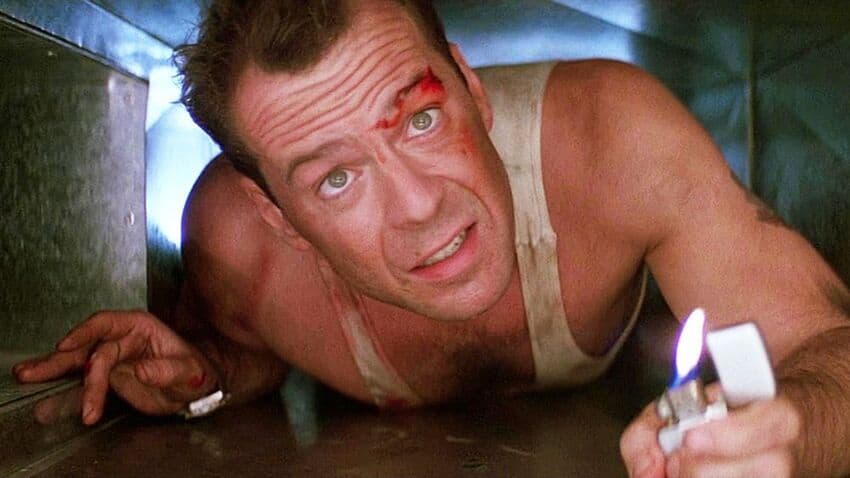
Die Hard didn’t just launch a franchise — it reprogrammed the action hero. Suddenly, heroes could be scared, sarcastic, bleeding, barefoot. Strength wasn’t just muscle anymore — it was endurance, attitude, and refusal to quit.
Arnold famously dismissed Willis early on, claiming he’d never be a real action star because of his “toothpick arms.”
Then Die Hard exploded.
The battlefield suddenly had a third front.
Planet Hollywood and the End of the War
The moment that truly mattered wasn’t a movie — it was Planet Hollywood.
When Arnold, Stallone, and Willis stood together as co-founders, it felt like Hollywood saying, Okay… we’re all rich. Let’s stop pretending we hate each other.
For the first time, audiences saw them share oxygen — not competing, not posturing. Just three alpha predators realizing the jungle was big enough for all of them.
The war cooled. The respect grew.
The Expendables: When Rivalry Became Canon
Then came The Expendables.
This was Stallone’s masterstroke. Instead of pretending the past didn’t exist, he turned it into the joke. Arnold showed up. Bruce showed up. And suddenly, the rivalry was official canon.
The first scene they share isn’t about plot — it’s about history. Three retired generals circling each other politely, trading barbs instead of bullets. No explosions. Just ego, legacy, and tension.
It felt like history happening in real time.
And when The Expendables 2 finally let them fight side by side? It didn’t matter that it came a little late. It mattered that it happened.
“I’ll be back.”
“Yippee-ki-yay.”
Closure.
Epilogue: When Legends Stop Competing
So what changed?
First: they survived.
Second: the genre moved on.
Third: they aged into icons.
Icons don’t need dominance. They need accuracy.
Arnold was never the enemy. Stallone was never the villain. Willis was never the outsider. They were mirrors — reflections of what audiences wanted at different times.
And when they finally stood together, the message was clear:
They made each other.
What began as competition matured into respect. Ego became legacy. War became mythology.
And for a few brief, beautiful moments — when Arnold, Sly, and Bruce shared the frame — Hollywood remembered what action movies used to be:
Loud. Personal. Thrilling. Ridiculous. Honest. Funny.
And absolutely badass.