


Buried in the leaf litter of the Brazilian Atlantic Forest lie members of what just might be the world’s cutest genus. The teeny tiny toadlets of the Brachycephalus group are super small frogs that currently number 42 species, and now another member has joined their ranks.
The rest of this article is behind a paywall. Please sign in or subscribe to access the full content.
Found in the Serra do Quiriri region, these tiny frogs were determined to be a new species through genetic analysis, morphological differences, and differences in the sounds of their advertisement call. Being so small but so noisy means these species are often easy to hear but difficult to see. Of the 42 known species, 35 have only been known since the year 2000.
These species have a high degree of variety, but many are bright colored, not least the newly discovered Brachycephalus lulai, which exhibits bright orange skin. It has also been named after the President of Brazil, Luiz Inácio Lula da Silva. “Through this tribute, we seek to encourage the expansion of conservation initiatives focused on the Atlantic Forest as a whole, and on Brazil’s highly endemic miniaturized frogs in particular,” explain the authors in the study detailing the new species.
Specimens of the frog were collected from the field and then taken to the lab for further study. This allowed the researchers to take detailed measurements and DNA samples to make sure what they were looking at was indeed a new species.
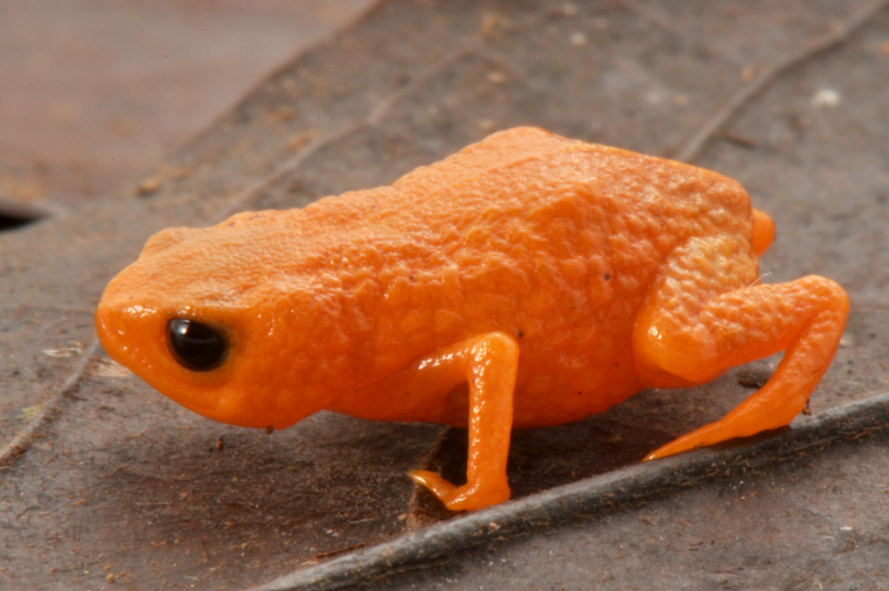
These frogs only measure 14 millimeters (0.6 inches) long.
As well as confirmation from the genetic results, the team determined it was a new species based on its rounded snout shape, bufoniform body shape, not having a fifth toe, and having black eyes, as well as a host of other factors. The body is mainly that bright orange, but the specimens were also found to have small patches of green or brown spots. The species is sexually dimorphic too, with the females found to be bigger than the males.
The Serra do Quiriri region, where B. lulai was discovered, is a mountain range in southern Brazil consisting of high grassland and cloud forest with mountain forest along the lower altitude slopes. The team estimates that the new species has a total range of around 8 square kilometers (3 square miles) in this area, and despite this small distribution, suggests that it belongs in the Least Concern category of the IUCN Red List.
The study is published in PLOS One.