


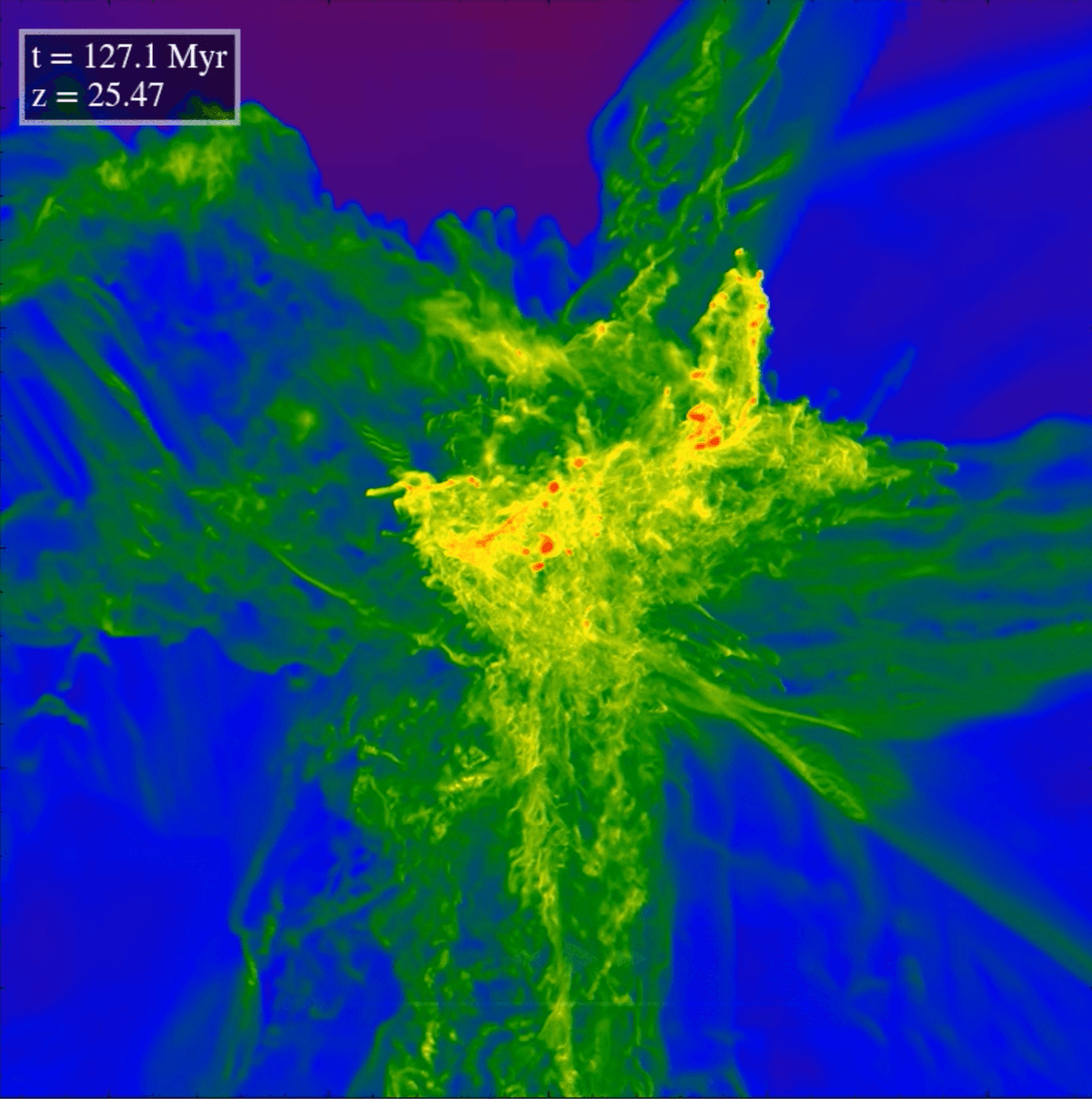
The first generation of stars that were born in the universe are a mystery. We can estimate when they existed and even how big they might have gotten, but direct evidence has been lacking. Now, JWST has found the most compelling proof of their existence, reporting a crucial signature of their presence in galaxy GS 3073.
The light of this galaxy comes from just over 1 billion years after the Big Bang. Using JWST, researchers were able to estimate the chemical composition of stars in this distant galaxy and found something extremely peculiar: an imbalance in the ratio of nitrogen to oxygen. This has been seen as evidence of the first stars, known as Population III.
Following the Big Bang, only three elements were created: hydrogen, helium, and a sprinkling of lithium. All the other elements we find in nature were formed in stars and stellar interactions. It took tens, if not hundreds, of millions of years for stars to form though, and many of those stars were truly massive. They are expected to weigh between 1,000 and 10,000 times the mass of the Sun.
Stars form from the fragmentation of massive clouds of hydrogen. While stars are very hot, their formation requires the gas to cool down and condense into a sphere. The most efficient way for these clouds to cool down involves heavier elements. The higher their percentage, the faster the cooling, and the smaller the largest possible star in that stellar nursery.
As we said, in the beginning, there was mostly just hydrogen, so some of the stars ended up being enormous, rapidly going through their fuel before exploding in spectacular supernovae. These explosions spread heavier elements into the galaxy and left behind very large black holes, maybe the seeds of the supermassive black holes at the center of galaxies. Finding them helps us understand the whole universe better – this is why this work is exciting.
“Our latest discovery helps solve a 20-year cosmic mystery,” co-lead author Daniel Whalen from the University of Portsmouth’s Institute of Cosmology and Gravitation said in a statement. “With GS 3073, we have the first observational evidence that these monster stars existed.
The researchers found that GS 3073 has a nitrogen-to-oxygen ratio of 0.46. This is far higher than what can be produced by any known stellar explosion. The team created a model that can explain this extreme ratio.
Stars fuse hydrogen in their core; that’s where their power comes from. Once stars have run out of hydrogen in their cores, they begin burning the helium produced in hydrogen fusion. Helium fusion produces carbon, and some of the carbon leaks into the hydrogen. Interactions between carbon and hydrogen produce nitrogen, and, being out of the nucleus, it is then distributed throughout the stars and spreads out when the star explodes.
Stars in the first generation came in all sizes; small ones might still be alive today, and we have simply missed their signals, but the big ones only existed then. The universe cannot make a star 1,000 to 10,000 times the mass of the Sun. The model in this work shows that the nitrogen-enriching process can only work for stars that are that big. So GS 3073 has a very exciting signature.
“Chemical abundances act like a cosmic fingerprint, and the pattern in GS 3073 is unlike anything ordinary stars can produce. Its extreme nitrogen matches only one kind of source we know of: primordial stars thousands of times more massive than our Sun. This tells us the first generation of stars included truly supermassive objects that helped shape the early galaxies and may have seeded today’s supermassive black holes,” added lead author Devesh Nandal, a Swiss National Science Foundation postdoctoral fellow at the Center for Astrophysics | Harvard & Smithsonian.
The team expects that JWST will find more galaxies with such an extreme nitrogen-to-oxygen ratio in the early universe, providing new insights into the first generation of stars.
The study is published in The Astrophysical Journal Letters.