


The BP (LSE: BP.) share price has spent years in the doldrums. A costly detour into renewables, heavy buybacks that stretched the balance sheet, and a prolonged slump in oil prices left investors frustrated and the stock drifting.
For much of the past year, crude hovered around $55 a barrel, and sentiment towards oil majors remained distinctly bearish.
But in just a couple of months, the picture has changed dramatically.
Oil prices had been creeping higher since the start of the year, and today (2 March) Brent crude surged 8% to around $80 amid escalating tensions in the Middle East.
Energy markets are now rapidly repricing supply risk, and early trading pushed the stock above 500p, its highest level in three years.
The question for investors is clear: is this merely another short-term bounce or the start of a far bigger comeback?
A business that still generates serious cash
Despite headlines around suspended share buybacks and a $4 bn impairment — mostly tied to low-carbon assets — its cash metrics remained strong.
Operating cash flow was $24.5 bn, underlying replacement cost profit $7.5 bn, and net debt fell to $22.2 bn. Even in a weak oil environment, BP can generate real cash.
Management’s medium-term targets assumed Brent at roughly $74 a barrel. With crude now pushing $80, the financial maths shifts. Higher prices feed directly into upstream margins and free cash flow, easing concerns over dividend cover and debt reduction.
In short, even when oil was weak, it was resilient. At $80, upside for cash flow, dividends, and potentially the share price looks more credible.
Dividends
The dividend remains central to the investment case. Although still below pre-2020 levels, the chart below shows that over the past five years the payout has risen from 21.63 ¢ to 32.96 ¢, a compound annual growth rate of over 11%.
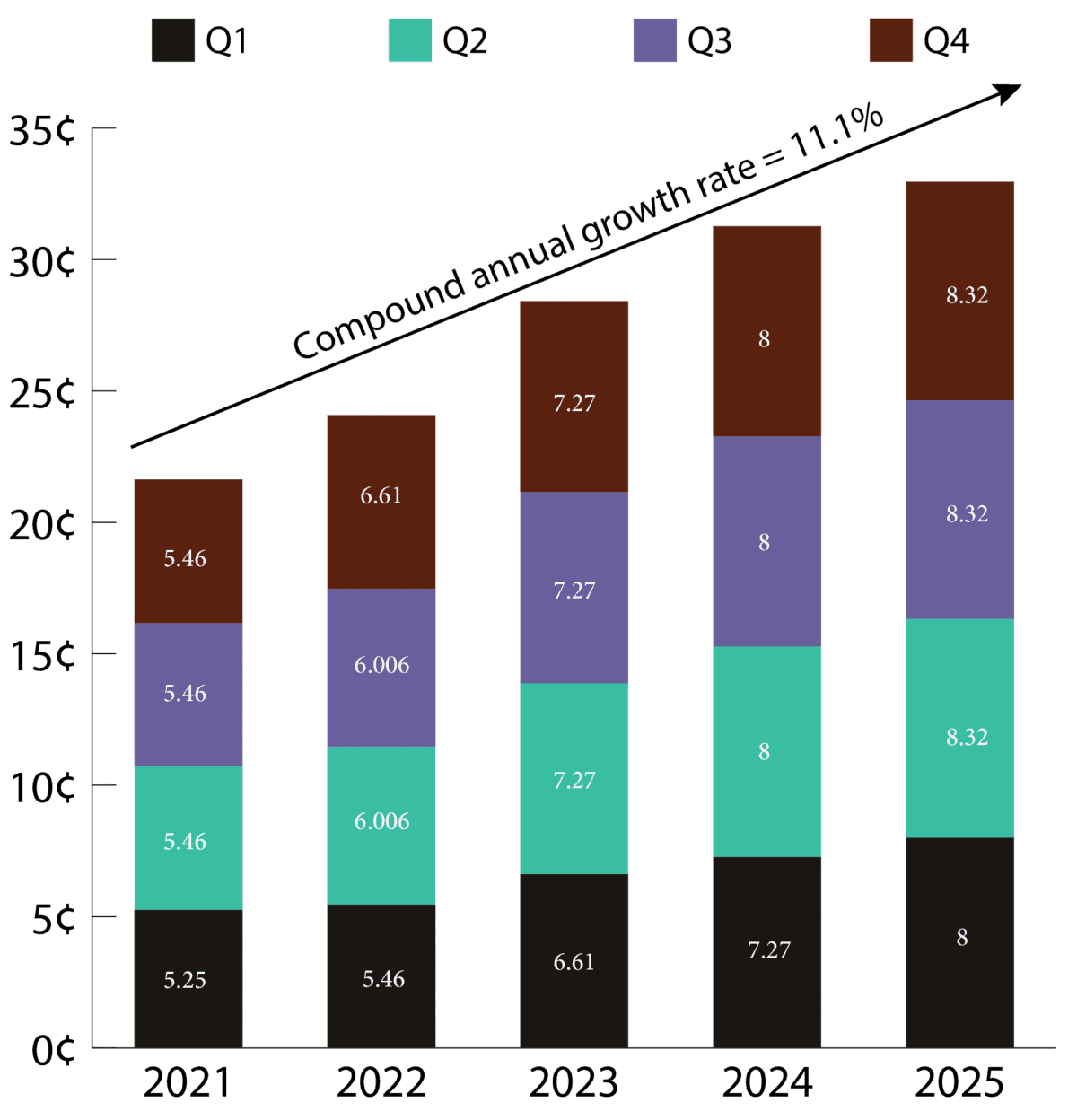
Chart generated by author
Since 2021, the dividend has consumed less than half of free cash flow, so it has been supported by real cash generation.
This underpins the stock’s appeal for income-focused investors, particularly those holding the shares in a Stocks and Shares ISA where dividends compound tax-free.
Please note that tax treatment depends on the individual circumstances of each client and may be subject to change in future. The content in this article is provided for information purposes only. It is not intended to be, neither does it constitute, any form of tax advice. Readers are responsible for carrying out their own due diligence and for obtaining professional advice before making any investment decisions.
Risks
BP faces a range of non-price risks though. These include regulatory pressures, potential tax or royalty changes, project delays, operational incidents, and challenges in executing its capital-allocation strategy. Even with strong cash flow, these factors could affect earnings, dividend sustainability, and investor sentiment, highlighting that the stock isn’t without exposure to unforeseen events.
Strategy and demand backdrop
The ‘peak oil’ narrative is fading. Markets assumed global demand would peak by 2030, shaping valuations and driving aggressive renewable pivots. But demand remains resilient: AI-driven data centres, emerging-market growth, and slow nuclear deployment mean hydrocarbons will stay central.
BP’s strategy reset reflects this. It’s focused on upstream growth, adding 150,000 barrels per day from six projects in 2025, while the Bumerangue discovery in Brazil strengthens its long-term production pipeline.
In today’s environment of elevated inflation and rising geopolitical tensions, oil and gas have proven their value. BP’s performance shows why the sector can help support a portfolio even when broader markets are under pressure.
For me, this resilience — combined with strong cash generation and a growing dividend — is a core reason BP remains a key holding in my ISA portfolio. For others, I see it as a stock to watch closely.