


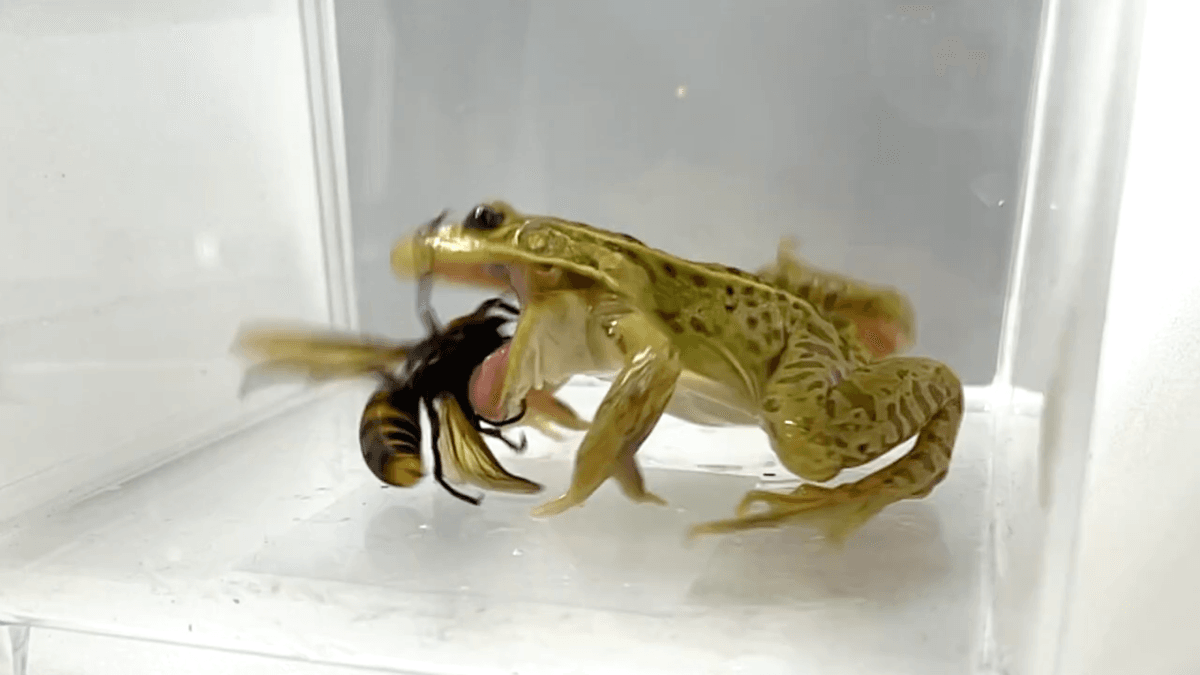
Giant hornets are typically not a force to be reckoned with. With size and a venomous sting capable of taking down a human on their side, there’s a good reason why they’re often called “murder hornets”. But now, new research has discovered an animal that snacks on these beasties like it’s no big deal – and even caught it on camera.
The rest of this article is behind a paywall. Please sign in or subscribe to access the full content.
The animal in question? A black-spotted pond frog (Pelophylax nigromaculatus). Previous work had already identified hornet remains in the stomach contents of this species, so it was already assumed they were likely capable of attacking and eating them. The question left unanswered was how; were these frogs just really good at avoiding getting stung, or did they have some sort of tolerance to it?
“Although stomach-content studies had shown that pond frogs sometimes eat hornets, no experimental work had ever examined how this occurs,” said Kobe University ecologist Shinji Sugiura in a statement.
Sugiura was about to change that. In the new study, he first placed individual pond frogs in a clear plastic cage, then presented them with a worker hornet of one of three species: the yellow hornet (Vespa simillima), the yellow vented hornet (V. analis), or the Asian giant hornet (V. mandarinia), the latter of which is the largest hornet species in the world.
Capturing the interactions on camera, Sugiura found almost all of the frogs actively attacked the hornets, with a 93 percent snacking success rate for V. simillima, 87 percent for V. analis, and 79 percent for V. mandarinia.
All the while, they were being stung; in one part of the footage, after a frog had successfully eaten a hornet, the stinger can be seen embedded in the frog’s mouth. And yet, the frogs studied came out of the ordeal seemingly unbothered and with a tasty snack in their belly. In other words, these unsuspecting pond frogs appear to be highly tolerant to the hornet’s sting.
“While a mouse of similar size can die from a single sting, the frogs showed no noticeable harm even after being stung repeatedly. This extraordinary level of resistance to powerful venom makes the discovery both unique and exciting,” said Sugiura, who suggested that black-spotted pond frogs could become a model organism for investigating venom tolerance and pain resistance in vertebrates.
Future work, he said, could examine “whether pond frogs have physiological mechanisms such as physical barriers or proteins that block the pain and toxicity of hornet venom, or whether hornet toxins have simply not evolved to be effective in amphibians, which rarely attack hornet colonies.”
The study is published in Ecosphere.