


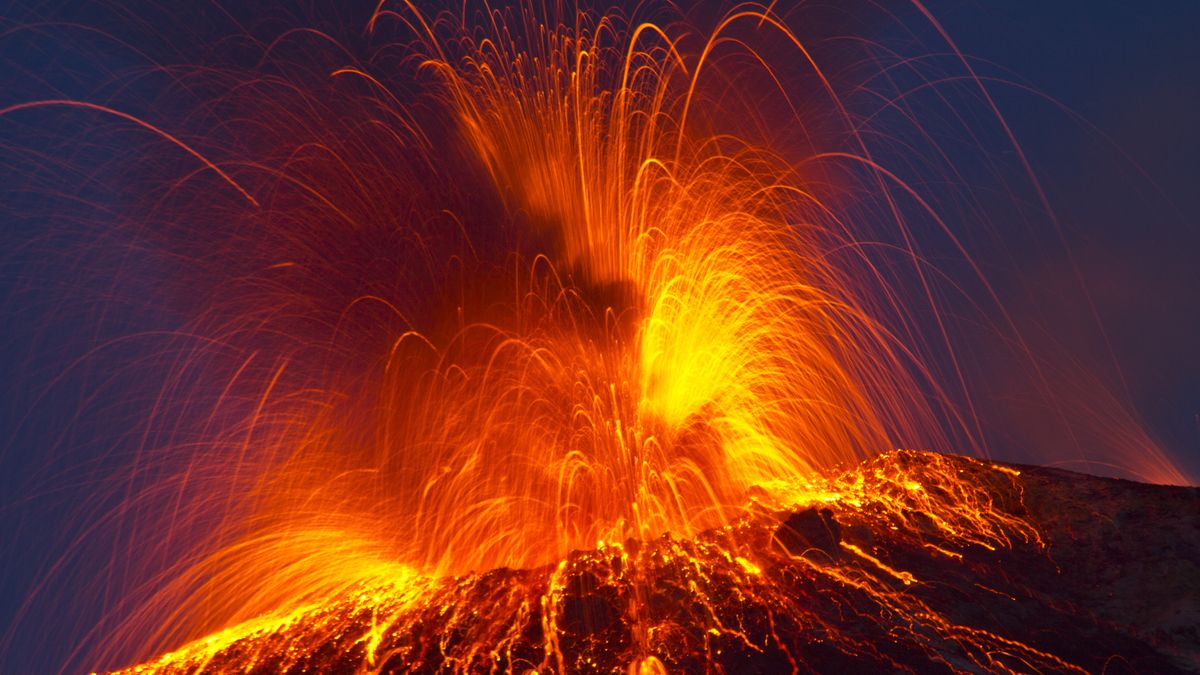
While some volcanoes have spent the last 2,000 years sleeping soundly, Stromboli, a volcanic island to the north of Sicily, has taken no such rest. In fact, it’s spent nearly all of that time in an almost constant state of eruption.
The rest of this article is behind a paywall. Please sign in or subscribe to access the full content.
Although some volcanologists have proposed that Stromboli may have been erupting even longer, it’s generally accepted that the first record of an eruption dates back to 350 BCE, with further reports suggesting that it’s been nearly continuously spitting out lava ever since.
The vast majority of these eruptions, while explosive, are typically mild and come in short bursts of lava, rather than producing a long-lasting column of eruptive material. That’s not to say that they aren’t worth looking at; so dazzling are Stromboli’s explosions that it’s earned the volcano the nickname “lighthouse of the Mediterranean”, its incandescent, firework-like bursts of lava providing a bright orange glow in the night sky.
These frequent, moderately explosive eruptions have even lent their name to a style of eruption – Strombolian, used to describe intermittent, discrete, and short-lived explosions that send basaltic lava anywhere from tens to up to hundreds of meters into the air.
More violent eruptions at Stromboli are rarer, but they have happened. A particularly intense period of activity began in May 1910 and wouldn’t end until July 1931, during which time several people would be killed as a result of the volcano’s eruptions.
One notable incident came on May 22, 1919, when a barrage of eruptive activity caused a 1,000-kilogram (2,205-pound) block of debris to fall on the island’s village, vegetation fires, and a tsunami, leading to the destruction of between 10 to 20 houses, several injuries, and the death of four people.
And there was more to come. On September 11, 1930, Stromboli’s strongest eruption of the 20th century would occur. That morning, the volcano experienced two strong explosions that produced a 2.5-kilometer (1.6-mile) high eruption cloud, highly destructive superheated clouds of volcanic gas and ash known as nuées ardentes that went speeding down into the sea, and huge blocks of debris – one weighing 30 tons – that landed nearby. Six people were killed in the carnage.
Stromboli quietened down again the following July, before producing another strong explosion a little under a year later. That eruptive episode would be short-lived. The next one? Not so much. The volcano kicked back into action on February 2, 1934, and it’s continued to erupt to this very day.